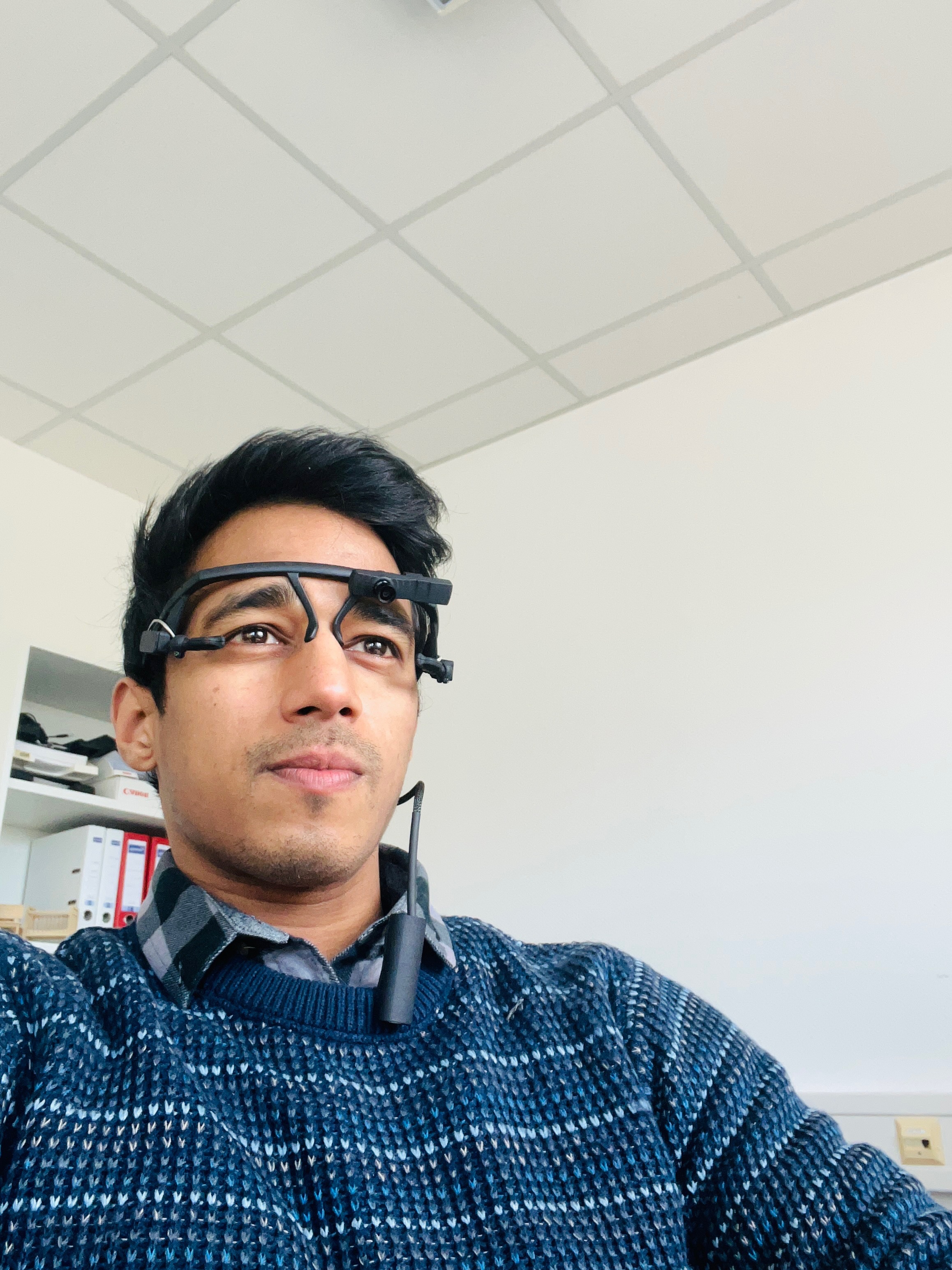
About Me
I am a postdoctoral researcher at SFB TRR318 “Constructing Explainability”, a Collaborative Research Center at Paderborn University and Bielefeld University. I am working in Project A05 alongside its PI, Prof. Dr. Katharina J. Rohlfing and Prof. Dr.-Ing. Britta Wrede.
Before joining SFB, I spent a wonderful year as a Junior Research Fellow (JRF) at the Indian Institute of Technology Guwahati. Previously, I completed my Master’s in Cognitive Science and Bachelor’s in German Language and Linguistics at JNU, New Delhi.
Research Interests
Most of my research is motivated by interdisciplinary approaches in cognitive science and psycholinguistics.
In my PhD, I worked on developing a framework of contrastive guidance by extending the idea of contrastive explanations (a popular method in explainable AI) from unidirectional settings to interactive human–AI explanatory tasks.
Currently, my research interests include:
Dialogue Modelling: I am interested in deriving computational and cognitive models of scaffolding from human–human explanatory settings. To do so, I work with multimodal interaction analysis, psycholinguistic experimentation, foundation models, embedding architectures (e.g., BERT), and Bayesian hierarchical models (RStan).
Social Explainable AI: This line of research is inspired by recent work in the TRR on sXAI. I am interested in investigating and modelling dialogical processes in human–human explanatory setups to derive and test desiderata of successful explanations for interactive systems. Along this line, I have investigated contrastive guidance and its implementation in human–robot explanatory settings.
Human–Robot Interaction: I am also interested in understanding real-time language–vision correspondence in human–robot explanatory setups and how it can inform XAI research. To this end, I am currently working to bring established methods from cognitive science, such as the visual-world paradigm, into HRI research.
Updates
Presented our work at IEEE ICDL Conference, Kyoto, Japan Title : A Divergence Model of Scaffolding in Dialogue via Negation. Read more
Call for papers: 4th TRR 318 Conference
Scaffolding Social XAI, Paderborn. Submission deadline: 1 November. Submission details
🎉 Paper accepted for publication in the Journal of Psycholinguistic Research
Our paper A Methodological Framework for Studying Online Language–Vision Interplay in Human–Robot Interaction has been accepted for publication in the Journal of Psycholinguistic Research, Springer Nature. https://rdcu.be/fBGkH
🎉 PhD successfully defended 🎓
I successfully defended my doctoral dissertation, From Negation to Contrast and Context: A Framework for Contrastive Guidance of Actions in Interaction. Link
🎉 Paper accepted for presentation at IEEE ICDL 2026
Our paper A Divergence Model of Scaffolding in Dialogue via Negation has been accepted for presentation at the IEEE International Conference on Development and Learning (ICDL 2026). Preprint
🎉 Paper accepted for publication in Acta Psychologica
A recent paper analysing eye-tracking data from a preferential-looking paradigm has been accepted for publication in Acta Psychologica. Link
The open-access book on Social Explainable AI (sXAI) is now out. Read
I contributed a chapter on Explanation Goals. Link
TeaP 2026, Tübingen
I recently presented my work at TeaP 2026 in Tübingen. Read the abstract
IEEE ICDL 2025, Prague
At IEEE ICDL 2025 in Prague, I gave a talk on language-vision interaction in human-robot interaction. Watch the talk on YouTube